library of patina
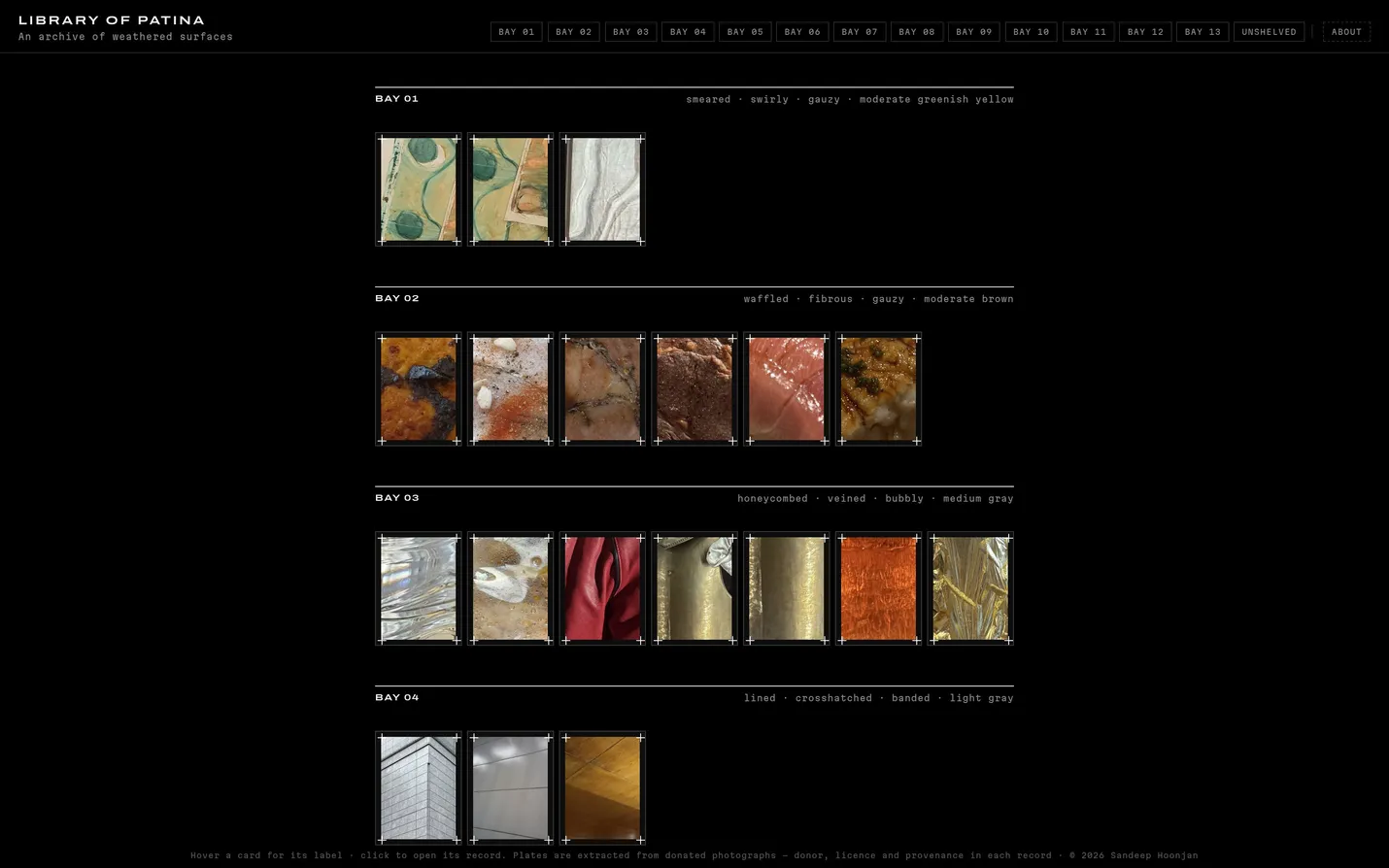
The Library of Patina is an archive of weathered surfaces, built from the photographs of my own life. Each holding is a plate, a tight crop of pure texture in which the thing it came from is no longer legible. The texture is the specimen, and every plate is free to download and use under an open licence.
The thinking follows Boris Groys's argument that collecting is what produces order, not the world.[1] So the library refuses every category an image cannot testify to, no material, no process, no cause, and instead shelves plates by resemblance alone, in the spirit of Warburg's Bilderatlas.[2] The bays are re-derived each time new plates arrive, so the catalogue rewrites itself as the collection grows.
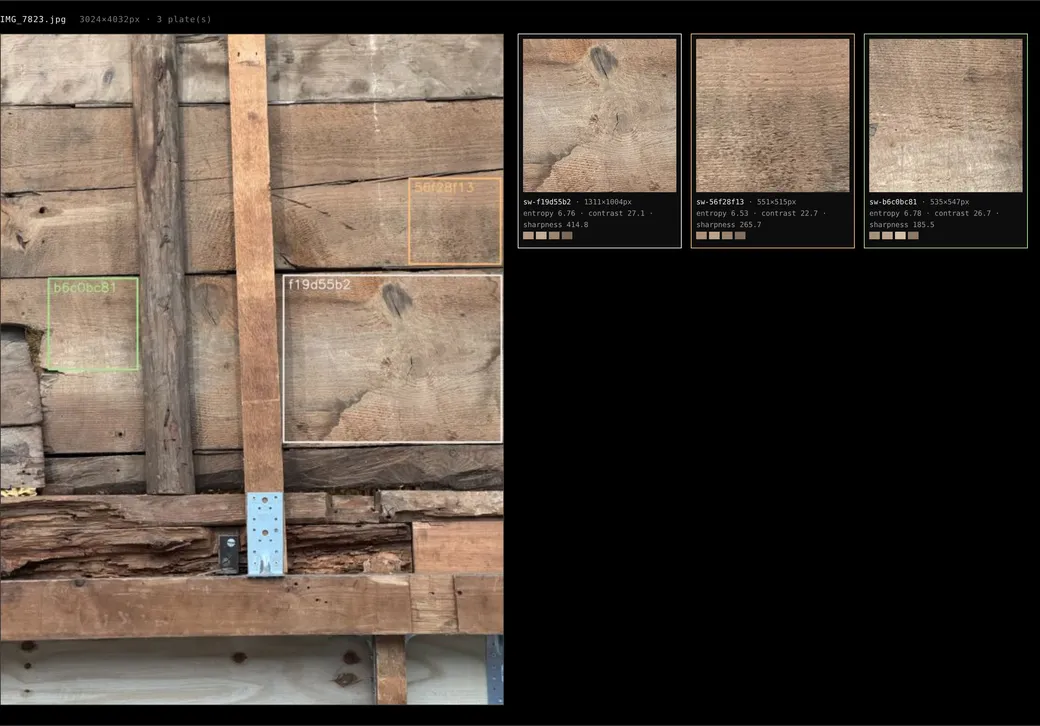
I built surface-works, an open pipeline that cuts plates from ordinary photographs. The Segment Anything Model proposes surface regions,[3] gates for texture and sharpness cull them, and I accept or reject every survivor by hand. A record keeps only what the image can say. Pattern is ranked against computer vision's forty-seven describable texture attributes,[4] colour is named from the plate's dominant colour, and character captures its coarseness, contrast and directionality. Accession numbers follow Spectrum, the UK museum standard, and encode nothing.[5] Shelving comes from self-supervised vision features blended with colour at a stated ratio and clustered into bays,[6] and plates no bay claims stay honestly unshelved.

The library itself is a register I designed and built with Three.js. Each bay files its plates as specimen cards, and the whole interface speaks in the mono voice of an accessions ledger.
Every record opens beside a live application room, where the plate auditions as a material, tiled across an untextured form at an adjustable scale or pressed onto it locally as stamps. The tiling is a repeat-wrapped texture and the stamps are decals projected onto the geometry along the surface normal.
The library is a working project. At the time of writing it holds 105 plates from 73 photographs, and it grows as photographs are donated.
- [1] Groys, B. (2021). Logic of the Collection. Sternberg Press. sternberg-press.com/product/logic-of-the-collection/
- [2] Wikipedia. Aby Warburg and the Mnemosyne Atlas. en.wikipedia.org/wiki/Aby_Warburg
- [3] Kirillov, A. et al. (2023). Segment Anything. arXiv. arxiv.org/abs/2304.02643
- [4] Cimpoi, M. et al. (2014). Describing Textures in the Wild. The Describable Textures Dataset, Oxford VGG. robots.ox.ac.uk/~vgg/data/dtd/
- [5] Collections Trust. Spectrum, the UK collections management standard. collectionstrust.org.uk/spectrum/
- [6] Oquab, M. et al. (2023). DINOv2: Learning Robust Visual Features without Supervision. arXiv. arxiv.org/abs/2304.07193